Batch Rotary Drum SSP vs Continuous SSP for rPET Production
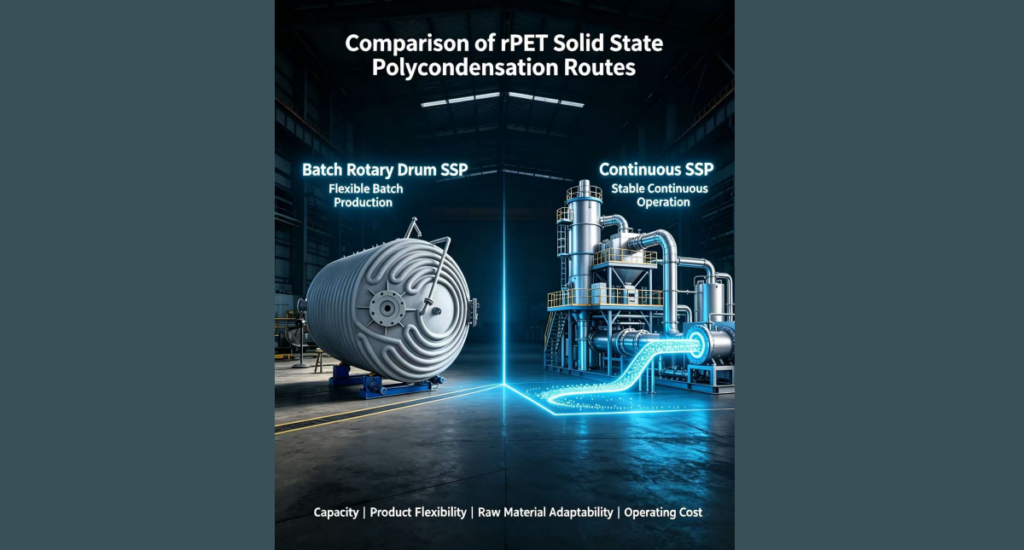
Solid state polycondensation (SSP) is widely used to raise IV value and remove acetaldehyde for recycled PET. The two mainstream technologies are batch rotary drum SSP and continuous fluidized bed SSP. Neither is universally better, the choice depends on capacity, product mix, budget and raw material.
Batch Rotary Drum SSP
Batch type operation. PET flakes or pellets are loaded into a rotary pressure drum. Under high temperature and high vacuum, materials tumble slowly to build IV. After reaction, cool down and discharge before next batch.
✅ High flexibility, easy recipe switching for strap, yarn, bottle-grade rPET.
✅ Better tolerance for fluctuating recycled PET flakes.
✅ Lower CAPEX, simpler civil construction, easy batch traceability for food grade.
❌ Higher energy consumption for heating-cooling cycles; limited single-line capacity.
Continuous SSP
Material flows continuously through pre-crystallization, heating, fluidized bed reactor and cooling section, non-stop production.
✅ Low specific energy consumption under stable full-load mass production.
✅ Excellent IV consistency for large-volume single product.
❌ High capital investment, poor flexibility. Product grade change creates large amount of transition waste. Strict requirement for stable pellet feedstock.
Which one to pick?
Choose batch drum SSP: Capacity below 3t/h, multiple product grades, PET flakes as feedstock, limited budget, frequent sampling & trial production.
Choose continuous SSP: Capacity ≥3t/h, single product, stable pellet raw material, long-term 24h continuous operation.
CTA: Contact us to get your custom Batch SSP process proposal and IV simulation.