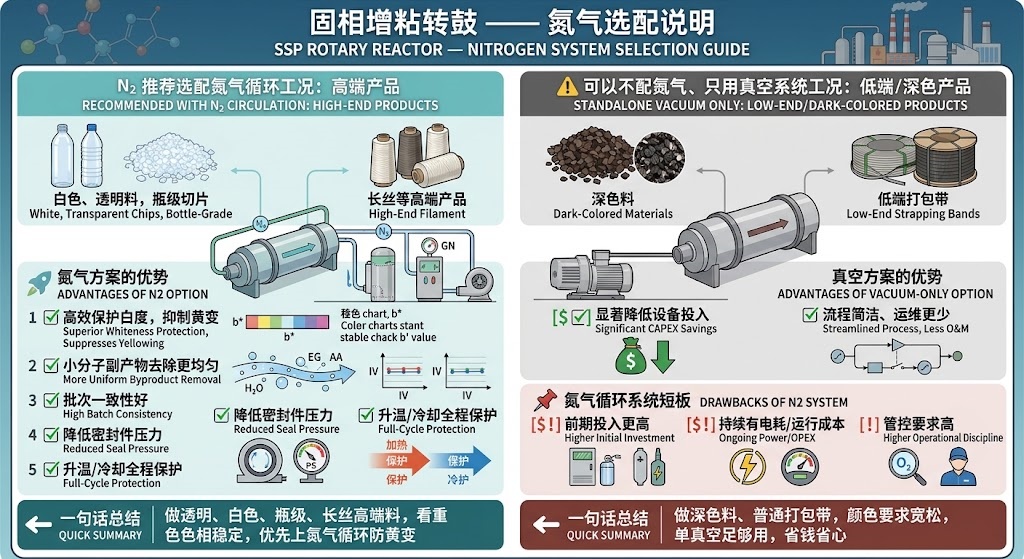
When selecting a Rotary SSP Reactor, many clients ask the same question: Do we really need to equip the system with a Nitrogen (N2) Circulation Loop?
In short: Nitrogen protection is not mandatory for all materials. The choice depends entirely on your product application, color index requirements, and overall quality standards.
Recommended with Nitrogen Circulation: White/Transparent Chips, Bottle-Grade PET, High-End Filament, etc.
These high-end products have stringent requirements for color tone, whiteness, and transparency. During high-temperature processing, exposure to oxygen easily triggers thermal-oxidative degradation, causing yellowing, browning, and significant color variation between batches.
Equipped with a Closed-Loop Nitrogen System, high-purity nitrogen continuously purges internal air to create an oxygen-free protective atmosphere. This completely blocks oxidation at the root, ensuring exceptional and stable color quality across every batch.
Key Advantages of the Nitrogen Option:
- Superior Whiteness Protection: Significantly suppresses high-temperature yellowing, making it much easier to meet strict color parameters.
- Enhanced Volatile Removal: Nitrogen forced-convection heat transfer carries away low-molecular-weight byproducts (such as water, ethylene glycol, and acetaldehyde) far more effectively than vacuum alone, yielding a more uniform Intrinsic Viscosity (IV) lift.
- High Batch-to-Batch Consistency: Dramatically reduces variations in color and IV between production cycles, meeting the strict specifications of premium clients.
- Relieved Seal Pressure: Compared to ultra-high vacuum processing alone, the required vacuum seal precision is slightly reduced, easing seal wear and maintenance pressures over long runs.
- Full-Cycle Protection: Keeps material protected during the heating, reaction, and cooling stages—preventing secondary oxidation when unloading at elevated temperatures.
Standard Vacuum System Only (No Nitrogen Required): Dark-Colored Materials, Low-End Strapping Bands, etc.
For applications with low color sensitivity, darker raw materials provide high color coverage. Customers in this segment focus primarily on reaching target viscosity (IV) rather than strict whiteness or yellowing limits.
A standalone vacuum system is fully capable of evacuating moisture and reaction byproducts to complete the solid-state polycondensation process and meet basic production requirements.
Key Advantages of the Vacuum-Only Option:
- Lower Initial Investment (CAPEX): Eliminates nitrogen generators, purification units, air compressor, air dryer, and associated piping systems, saving significant upfront equipment cost.
- Streamlined Operation & Maintenance: Simpler process flow, reduced daily maintenance, and no ongoing nitrogen utility costs (OPEX).
Drawbacks & Trade-offs of the Nitrogen System
- Higher Capital Expenditure: Requires additional investments in nitrogen purification, circulation compressors, oxygen analyzers, and control instrumentation.
- Increased Operating Costs (OPEX): Continuous power consumption for the circulation loop, plus ongoing costs for filter replacements and minor nitrogen replenishment.
- Higher Operational Discipline: Requires daily routine checks to monitor N2 purity, residual oxygen levels, and circulation flow rates, placing higher technical demands on operators.
Quick Summary
- High-End Applications (Transparent/white materials, bottle flakes, high-tenacity filament): Choose Nitrogen Protection to prevent yellowing and secure premium color quality.
- Standard Applications (Dark materials, industrial strapping): Vacuum-Only is Sufficient to hit viscosity targets while saving on upfront and operational costs.
0 Comments